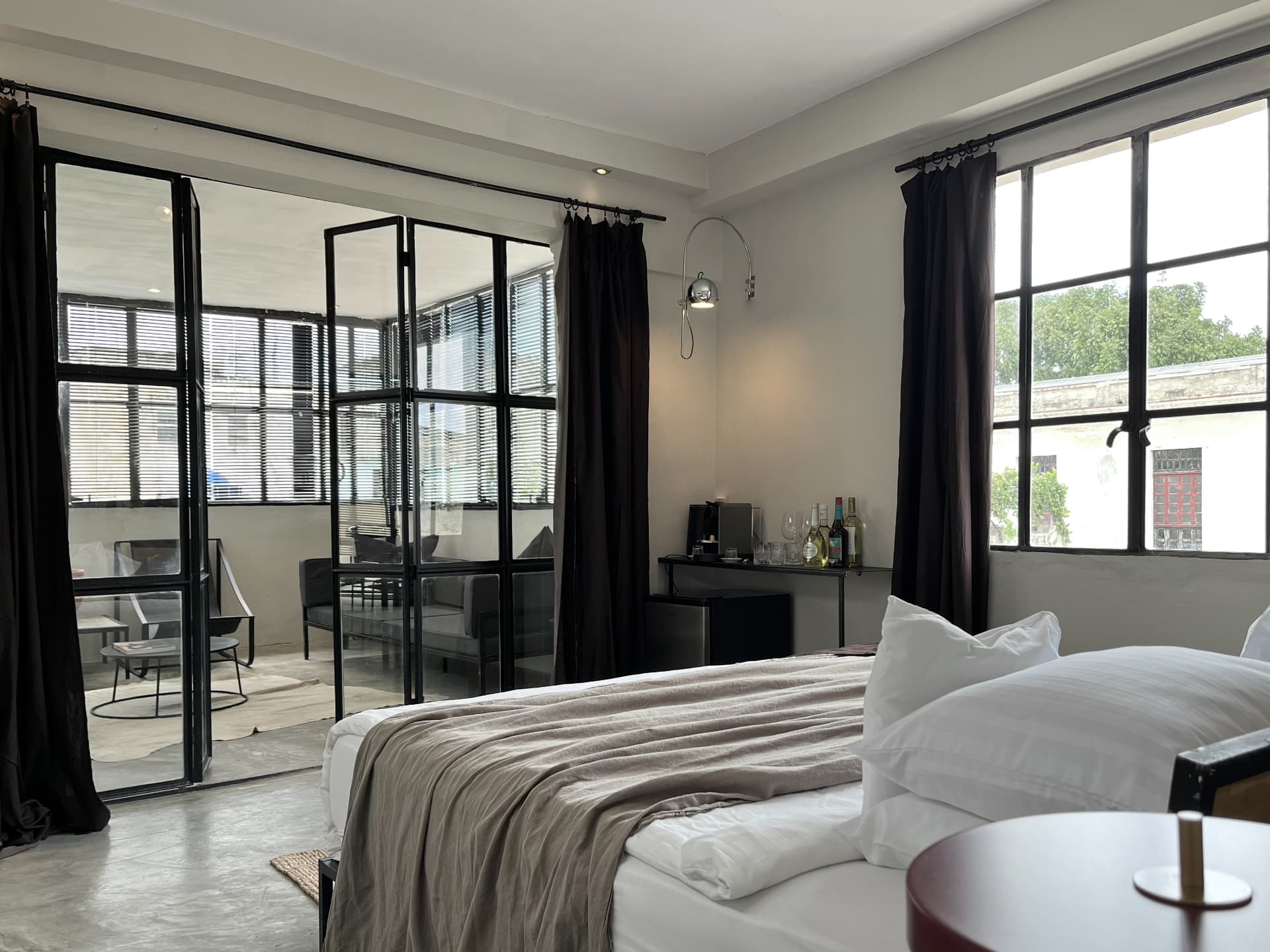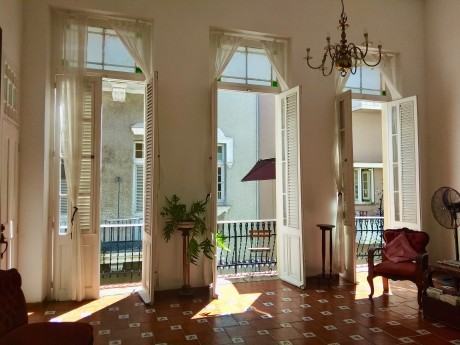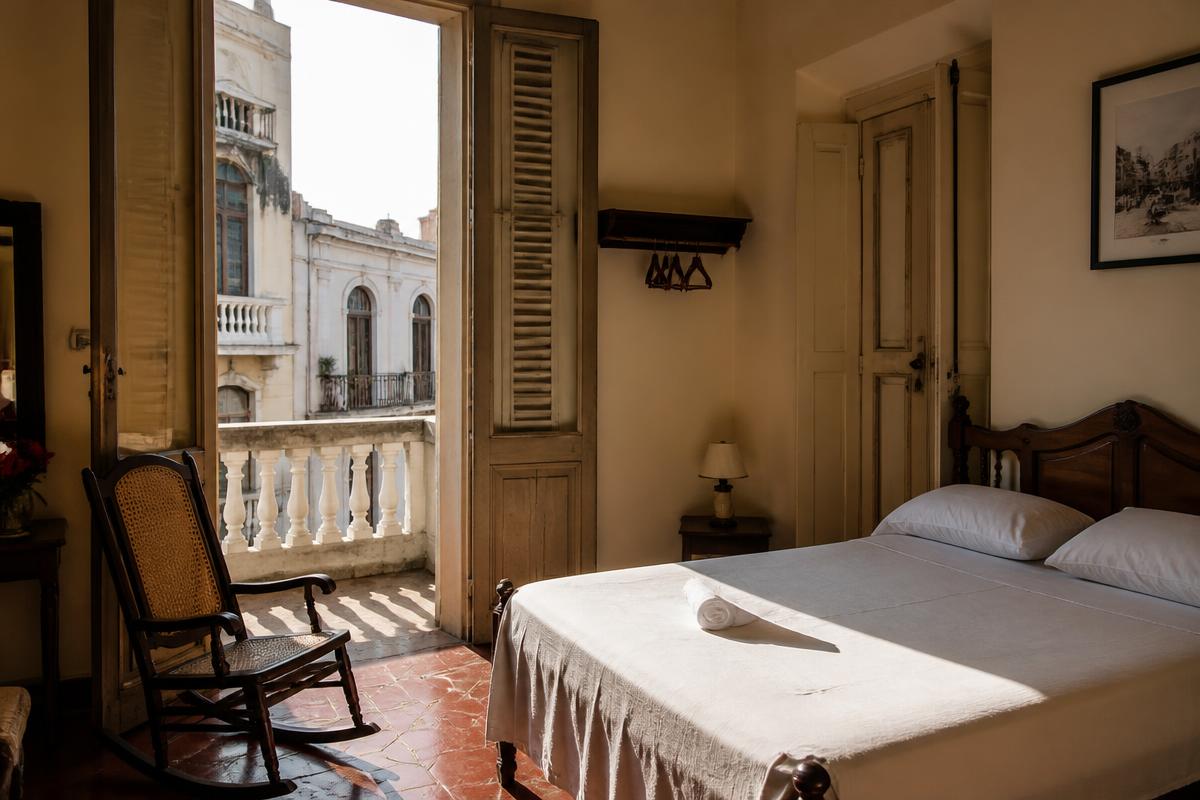
Your accommodation shapes a Cuban trip more than almost anything else — the meals, the neighbours, the pace. Here is a full stay mapped night by night, using privately owned casas only.
Why the lodging decision carries so much weight
In most destinations a room is a place to sleep between the parts of the trip that matter. In Cuba the room is a large part of the trip. Where you stay usually determines where you eat breakfast, who answers your questions about the neighbourhood, whether you have reliable hot water and connectivity, and how much genuine contact you have with the people who live there. Two travellers on identical routes can come home with completely different impressions of the country based on nothing more than the houses they booked.
This guide walks through a full Cuban stay from the perspective of lodging: what to book, where, and why, from your first night to your last. Every stay described here is a privately owned, independently run home — casas particulares, private guesthouses, rural farm stays and whole-home rentals. US travellers under a general licence should book private accommodation only and keep their own records of where they slept and what they paid.
The private-stay options, side by side
A casa particular is a privately owned home licensed to host guests — Cuba's version of a bed and breakfast. They range from a single spare room in a family apartment to a restored colonial house with four or five guest rooms and a courtyard. Breakfast is normally an inexpensive add-on and is frequently the best meal of the day: fruit, eggs, bread, strong coffee and fresh juice, served at whatever hour you ask for.
A whole-home rental gives you the entire property: your own kitchen, your own keys, no shared spaces. Private guesthouses sit in between — several rooms run with more structure than a family home, still privately owned. Rural farm stays, common around Viñales, are family properties on working land where dinner is grown a few metres from the table. Choosing between them is mostly a question of how much privacy you want against how much local guidance you want on hand.
Night one: arriving in Havana
Most travellers settle into a casa in Habana Vieja or Vedado for their first nights. Before you confirm, check four things: that the bathroom is private rather than shared, that the room has working air conditioning, that there is a courtyard or roof terrace if that matters to you, and that breakfast can be arranged. Ask for the cross street, the floor and the host's phone number in writing, and save them offline — street numbering in the old city is inconsistent and your phone may not be online when the taxi drops you.
Arrange your airport pick-up with the host in advance rather than improvising at the terminal. A private driver arranged through the house costs roughly what a taxi costs and removes the one moment of the trip where jet lag, no connectivity and an unfamiliar address collide. Tell the host your flight number and expect a relaxed attitude to check-in times; hosts wait, but they appreciate knowing when.
Nights one to four: settling into the city
For a multi-night Havana stay you can either keep one casa throughout or split the stay: a few nights in Habana Vieja for the historic core, then a few in Vedado or Miramar for a quieter, residential rhythm. Splitting costs you a morning of moving bags but shows you two genuinely different cities. Keeping one base buys you a host who has learned what you like by day three.
Meals in this stretch settle into a pattern: breakfast at the casa, lunch at a paladar — a privately owned restaurant — near wherever you spent the morning, and dinner at another paladar or on a private rooftop. Many hosts will also cook dinner on request if you ask a day ahead. It is usually the most memorable meal of the week and among the cheapest, and it keeps your spending in private hands, which is exactly where a US traveller's spending should sit.
Night five: moving to a second region
This is where the character of the trip is decided. Viñales gives you tobacco country and limestone mogotes, with casas that are often working family farms with valley views and dinner included by arrangement. Trinidad gives you cobblestones and colonial architecture, with casas clustered in the historic centre within earshot of live music courtyards. Cienfuegos and Santa Clara give you wide boulevards, neoclassical squares and a slower, less-visited pace, with well-kept private homes at gentler prices.
Book the onward leg before you leave Havana. Intercity travel is usually a shared or private car arranged through your host, who will call a driver they have used for years; agree the price and the pick-up time the night before. Coordinate arrival with the next house so someone is home, and forward the new address to your current host in case the driver needs directions on the way.
Nights five to seven: the regional stay
The lodging experience shifts noticeably once you leave the capital. Viñales casas commonly include a home-cooked dinner: rice, beans, pork or chicken, root vegetables and salad, much of it grown on the property. Trinidad casas put you steps from courtyard music and family-run kitchens. In both, the host is your best source for anything you want to do — horseback rides through tobacco fields, a valley walk, a tour of a private farm — arranged directly with independent local operators.
Expect the practical details to be simpler and more variable than in the city: hot water may run on a tank schedule, connectivity may mean a data card and a spot on the porch, and power can flicker. None of it is a problem when you know in advance. Ask the host how the water and electricity work on your first evening rather than discovering it at seven the next morning.
The final nights and the flight home
If you fly out of Havana, plan one last night back in the capital rather than attempting a long drive on the morning of departure. Many travellers return to their arrival casa; hosts remember returning guests and will often hold a preferred room. Confirm that final night at the same time you book the first one, since the last-minute version of this booking is the hardest one to make.
For an early departure, choose a private home closer to the airport road rather than deep in the old city, purely to shorten the last transfer. Arrange the driver the day before, ask the host for a packed breakfast if you leave before dawn, and settle the bill in cash the previous evening so the morning is nothing but a door and a car.
A full-stay plan you can copy
A dependable arc looks like this: three or four nights in a Havana casa, two or three nights in a Viñales farm stay or a Trinidad colonial casa, optionally two nights in Cienfuegos or Santa Clara on the way back, and one final night in Havana before departure. Ten nights, three or four houses, every one of them privately owned. Book the whole arc as one itinerary rather than piecemeal so no leg is left hanging.
Budget roughly $40–70 per night for a private casa, $15–25 for a host-cooked dinner and $10–15 for breakfast, then add a 15–20% cushion for drivers and changes of plan. Keep written confirmations, receipts and the names and addresses of every house you stay in. US travellers are responsible for choosing a qualifying travel category, for staying out of restricted state-owned properties, and for retaining those records for five years.
Booking happens on our partner's site — we never take payments here.
Book Now